Introduction
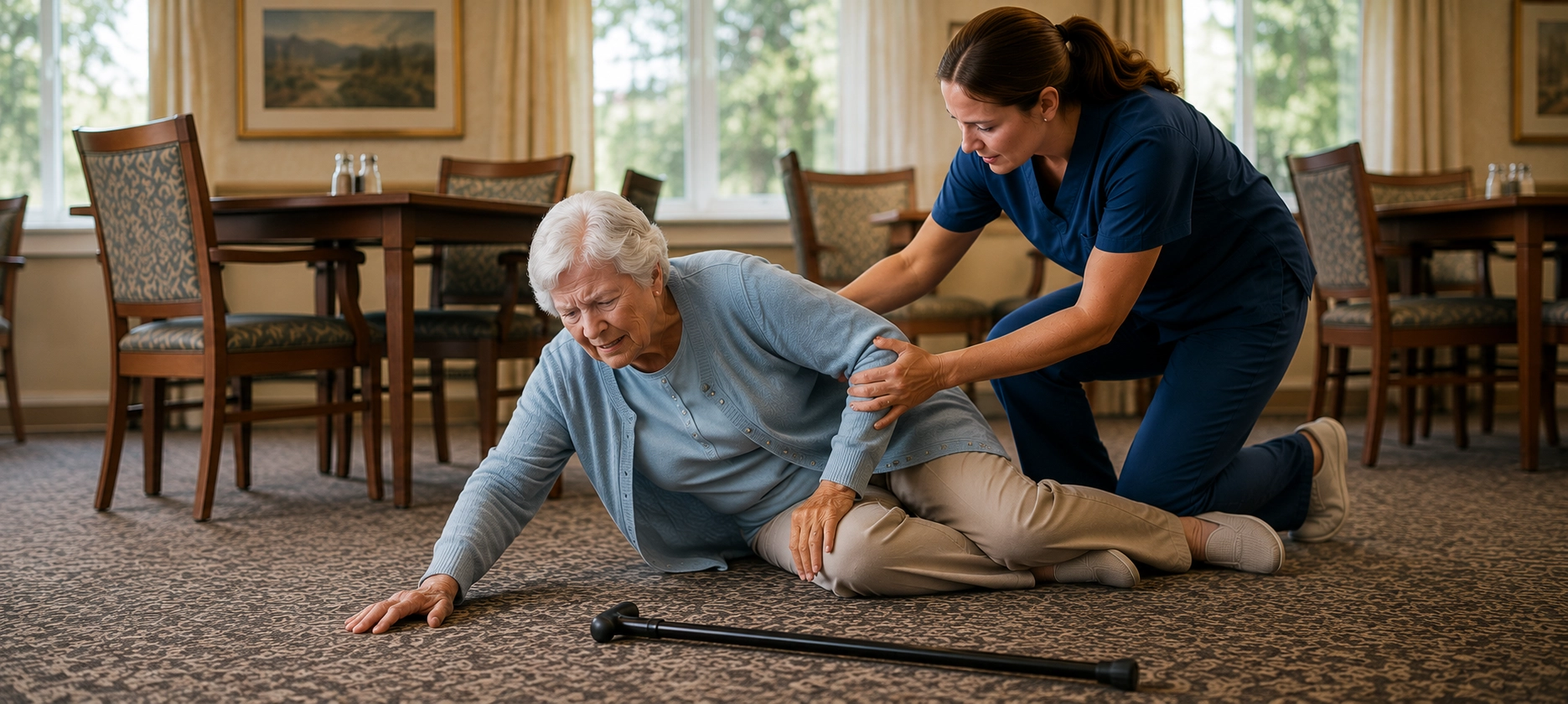
Falls in senior care communities are among the most studied, most documented, and most costly events in long-term care. Yet one contributing factor remains almost entirely overlooked in fall prevention literature and facility safety audits: the dining chair.
Not because the connection is obscure. The connection is obvious once you watch what happens at mealtime in any community where residents need seating assistance. There is a specific, repeatable sequence of movements that creates vulnerability and that sequence is built into the design of every standard dining chair ever made.
Understanding what happens, and why, is the first step toward eliminating one of the most preventable fall risks in senior care.
The Trip Zone: What It Is and How It Forms
When a caregiver assists a resident in getting seated at a dining table, a standard chair cannot be positioned directly in front of the seat. The chair must be angled, typically at 45 degrees, to allow the resident to approach and lower themselves without the table blocking the movement.
This positioning creates what the DCCS calls the Trip Zone: the area immediately surrounding the front of the table where both the resident and the caregiver must navigate simultaneously while one of them is in the process of transferring weight.
In this zone, both parties must shuffle sideways, step backward, and use the table edge for balance. The caregiver is managing a partially seated person while in motion. The resident is managing their own balance during the most physically demanding part of the meal. And a standard chair, designed to stay exactly where it is sits between them, immovable and uncooperative.
Why Falls Cluster Near the Table
Falls in senior dining rooms do not happen randomly across the space. They cluster in a specific location: at the moment of seating and unseating, within arm’s reach of the table edge.
This pattern is not coincidental. It reflects the biomechanical demands of the transition moment — the instant when a person moves between standing and seated, or seated and standing, without a chair that accommodates that transition.
For residents with Parkinson’s disease, post-stroke weakness, hip replacement recovery, or general deconditioning, the demands of the standard chair transfer are often beyond what their stability can safely support. The chair does not adapt to them. They must adapt to the chair and sometimes, they cannot. resident experiences, enhance caregiver safety, and elevate the overall standard of care within their communities.
The Role of Flooring in Amplifying Risk
Modern senior care facilities have largely moved toward cushioned or resilient flooring a well-documented intervention for reducing injury severity when falls do occur. The floor absorbs impact. That is its job, and it does it well.
But cushioned flooring has an unintended consequence at the dining table. It increases the physical resistance required to move a seated person in a standard chair across the surface. Caregivers pushing an occupied chair on cushioned flooring are working against significantly more friction than on hard surfaces.
The result is that the very intervention designed to reduce fall injuries softer flooring increases the physical strain on caregivers during the seating process, which in turn increases the chance of a loss of control during transfer.
What Eliminating the Trip Zone Looks Like
The DCCS addresses the Trip Zone directly through Classes B, C, and D seating designed to provide full seat access without requiring the dangerous angled approach of a standard chair.
Full seat access means a resident can approach the chair from the front, lower directly into a well-supported seat, and be moved to the table while already seated without shuffling, without backward stepping, without table-edge balancing. The caregiver controls the movement of the chair, not the movement of the person.
This is not a small operational change. Facilities that have eliminated the Trip Zone from their dining rooms describe it as a fundamental shift in the mealtime experience for both residents and staff. Falls near the table decrease. Caregiver confidence increases. The dining room becomes what it was always meant to be: a place of nourishment and connection, not a site of preventable injury.