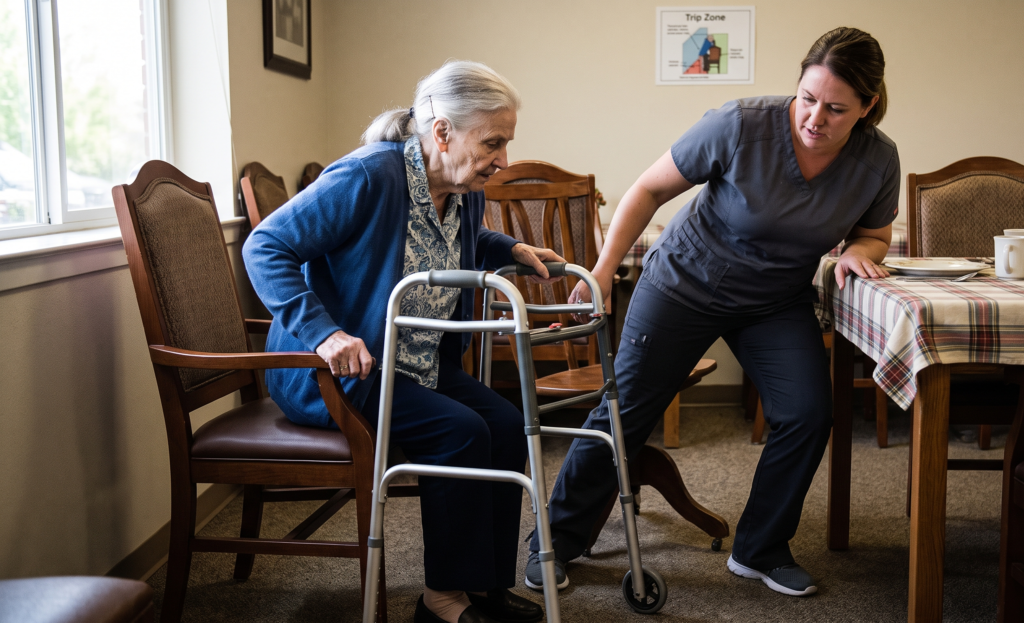
It is tempting to evaluate a dining chair in isolation. But a supportive chair that prevents a resident from reaching their plate has failed at the one task that matters. In senior living, the chair and the table must be designed and selected as a single system, because arm height, seat depth, clearance, and positioning together determine whether the meal actually succeeds.
The objective is easy to lose sight of in a showroom. A resident does not come to the table to sit; they come to eat, drink, and take part. Every design variable should be judged against that outcome — successful participation in the meal rather than against the comfort of the chair on its own.
Key takeaways
- The goal of dining seating is meal participation, not seating; a chair that keeps a resident from the table has failed even if it is comfortable.
- Arm height must be resolved against real table clearance, or bulky armrests will stop the chair short of the plate.
- Correct seat-to-table distance lets a resident eat with forearms supported and the plate in reach, without leaning or bracing.
- Chairs and tables should be evaluated together, on site, using the actual tables a community owns.
The objective is participation, not seating
Reframing the goal from comfortable seating to successful participation changes what counts as success. A chair earns its place not by how it looks empty but by whether the resident sitting in it can comfortably reach the table, eat and drink with dignity, and stay engaged for the length of the meal. Everything else is in service of that.
Designing for the range of bodies
A dining room seats a wide range of heights, builds, and abilities, and the chair-and-table relationship has to work across that range, not just for an average resident. A pairing that suits a tall, independent resident may leave a shorter resident unable to reach the table or get their feet planted. Selecting seating and tables together, with the actual population in mind, is what keeps the whole room usable.
Arm height against the table apron
If the armrests are too high or too substantial, they collide with the underside of the table the apron or rail beneath the top and stop the chair short, leaving the resident stranded inches from the plate. This is one of the most common and least noticed failures in senior dining. Arm height must be resolved against the real clearance of the tables in use. Table construction matters here too: a pedestal table clears armrests differently than a four-leg table with an apron, so the two decisions cannot be made independently.
Seat-to-table distance
The correct relationship allows a resident to sit with forearms comfortably on the table and the plate within easy reach, without leaning forward or bracing. When the distance is wrong, eating becomes effortful; food and drink are spilled, posture suffers, and dignity erodes meal by meal. Small, repeated indignities like these are exactly what a well-matched system prevents.
Positioning without the shuffle
On a standard chair, closing the final gap to the table means shuffling sideways, stepping back, and leaning for balance — the very movements that create fall risk in the space before the table. A chair designed as part of the table system closes that gap by design, so the resident is positioned rather than manoeuvred, and the hazard zone in front of the table is never entered.
Full seat access is also a table decision
The ability to bring a resident fully to the table, without requiring them to negotiate the hazard zone in front of it, depends as much on the chair-and-table relationship as on the chair alone. When the two are treated as one system, positioning becomes precise, respectful, and repeatable across every resident and every meal, and caregivers are no longer improvising around furniture that fights them.
How to audit your dining room’s chair-table fit
Administrators can assess the pairing directly, without specialist equipment. Working with a few representative residents and caregivers:
- Watch a real seating-and-positioning sequence and note where the resident has to shuffle, lean, or step back.
- Check whether the armrests clear the table apron, or whether the chair stops short of the plate.
- Confirm the resident can sit with feet planted and forearms comfortably on the table without reaching.
- Ask caregivers where the current furniture forces awkward pulling, pushing, or bending.
Specify the pair, not the piece
The practical implication is straightforward: evaluate seating alongside the actual tables it will serve, not in isolation. Measure the clearance, observe a genuine positioning sequence, and confirm that residents can get close enough to eat well because that outcome, not the fabric sample, is the purpose of a dining programme.
Frequently asked questions
What table height works best with dining chairs for seniors?
As with seat height, the right table height depends on the residents and the chairs it is paired with. The test is functional: a resident should be able to sit with feet planted, forearms resting comfortably on the table, and the plate within easy reach, while the chair’s armrests clear the underside of the table. Because it is a relationship, table and chair should be chosen together.
Why can’t some residents get close enough to the table?
The most common reasons are armrests that collide with the table apron and stop the chair short, and standard chairs that are difficult to position, leaving the resident stranded in the gap. Both are chair-and-table fit problems, which is why they are best solved by evaluating the two together.
What is full seat access?
Full seat access means a resident can be brought fully to the table without having to negotiate the hazardous space in front of it, the area where shuffling, stepping back, and leaning for balance cause trips and falls. Achieving it depends on both the chair and its relationship to the table.
Should we replace tables or chairs first?
Neither in isolation. Because participation depends on the fit between them, the better approach is to evaluate chairs against the tables you already own, and to change whichever element or both is required to let residents reach the table safely and comfortably.
Download the complete DCCS Decision Guide (PDF) for the full A–D framework and class-by-class detail. To discuss your community’s dining room, contact us or call 1-888-678-2060.