For most of the history of senior living, dining room furniture has been purchased the way restaurant furniture is purchased: by look, by price, and by durability. The question of whether the chair is appropriate for the person sitting in it specifically, for a person who may need help getting in or out of it has rarely been asked.
The DCCS changes that by giving care teams a vocabulary and a decision framework. Within that framework, two of the most commonly compared options are Class A and Class B. They may look similar in a catalog. In a care context, they operate in fundamentally different ways.
Class A: The Standard Chair and Its Appropriate Use Case
A Class A chair is what most people picture when they think of a dining chair: four legs, a back, a seat. It is designed to stay in place. Its stability comes from friction with the floor, from its own weight, and from the assumption that the person using it will position themselves independently.
For residents who are fully independent who can approach a chair, lower themselves without assistance, reposition if needed, and rise independently at the end of a meal a Class A chair is entirely appropriate. It is what they have used their entire lives, it requires no adjustment on their part, and it provides a normal, dignified dining experience.
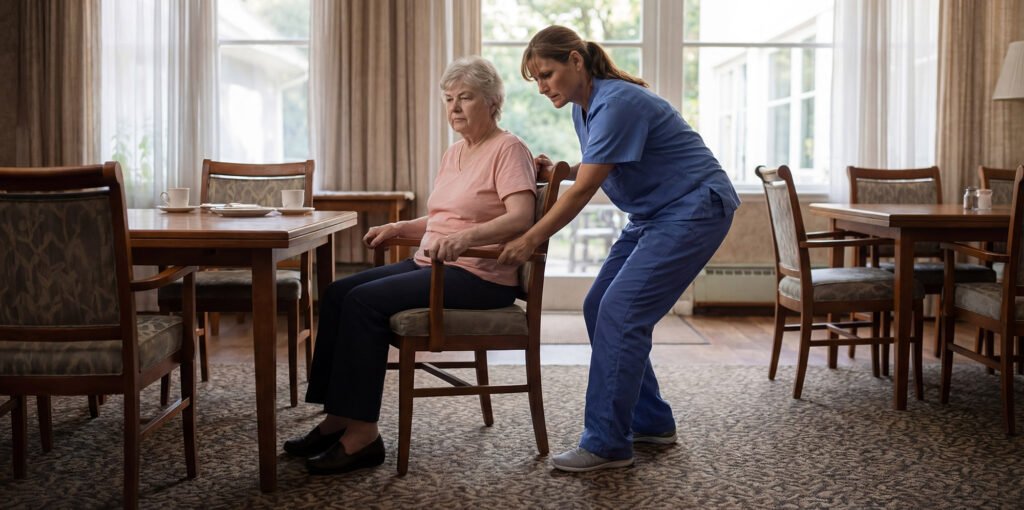
The problem arises when Class A chairs are used beyond this population. When a resident needs any degree of seating assistance even a hand for stability, even a light guide during lowering the Class A chair becomes the wrong tool. Its inability to move with the person, its resistance to caregiver positioning, and its creation of the Trip Zone make it a liability in any assisted seating scenario.
Class B: Guided Mobility Without Losing Stability
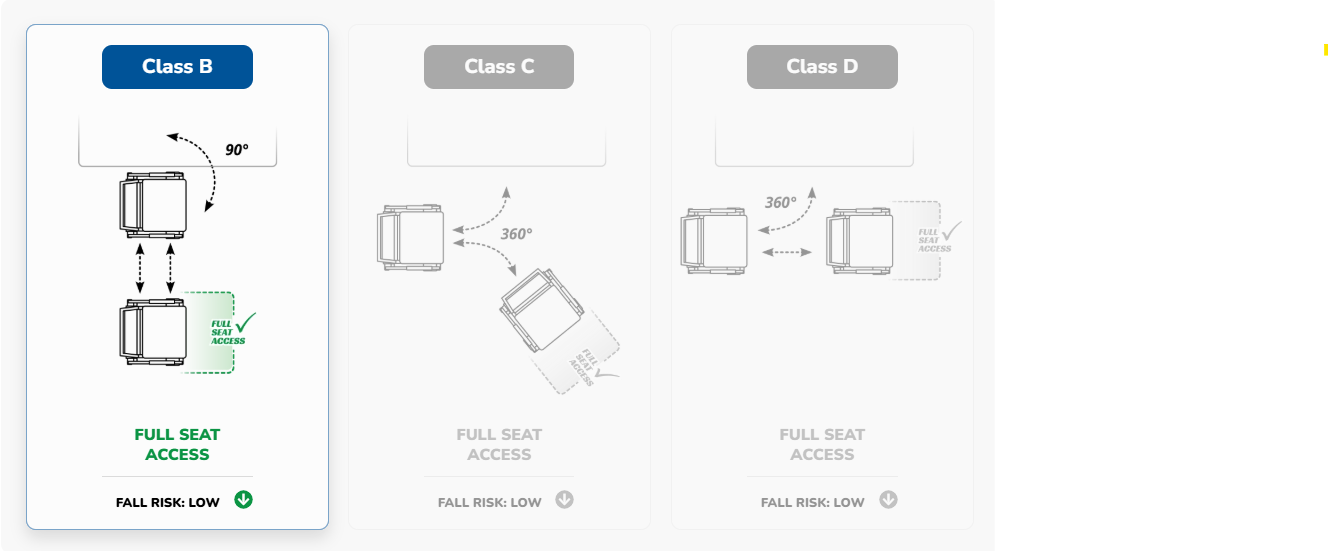
A Class B chair introduces controlled movement while maintaining the stability and appearance of a standard dining chair. The key innovation is the elimination of interference with the table during seating: a Class B chair allows the caregiver to position the resident without the angled approach that creates the Trip Zone.
Class B chairs are designed for residents who require occasional or stability support during seating the semi-dependent population that represents a significant portion of assisted living and long-term care communities. These are residents who can participate in the seating process but cannot safely manage the full demands of a standard chair transfer.
For these residents, a Class B chair provides full seat access: the resident approaches from the front, lowers into a well-supported seat, and the caregiver guides the chair to the table without backward stepping or lateral shuffling. The movement is controlled. The risk is reduced. The dignity of the dining experience is preserved.
How to Decide Which Class Your Residents Need
The decision between Class A and Class B is not made at the product level it is made at the resident level. The DCCS framework asks care teams to assess each resident’s mobility, balance, and seating assistance needs, then match the chair to that assessment.
A simple screening question can guide initial classification: does this resident require any physical assistance or prompting to sit down at the dining table? If the answer is no never, not even on a bad day Class A is appropriate. If the answer is sometimes, occasionally, or yes with light support, Class B is the minimum appropriate class.
Many facilities find that their dining rooms contain a mix of residents across all four classes, and that a blended approach different chair types for different dining areas or resident groups is more accurate than a single-class solution for the whole community.
The Cost of Getting It Wrong
Using a Class A chair for a resident who needs Class B or higher is not a neutral decision. It is a decision with predictable consequences: increased fall risk at the table, increased caregiver strain during every meal, accelerated chair wear from being pushed across flooring while occupied, and a seating experience that diminishes resident dignity.
These costs are rarely calculated because they are distributed across time and across departments. The fall gets attributed to the resident’s condition. The caregiver injury gets attributed to occupational wear. The chair wear gets attributed to normal use. None of it gets attributed to the chair classification decision because until the DCCS, there was no such decision to make.