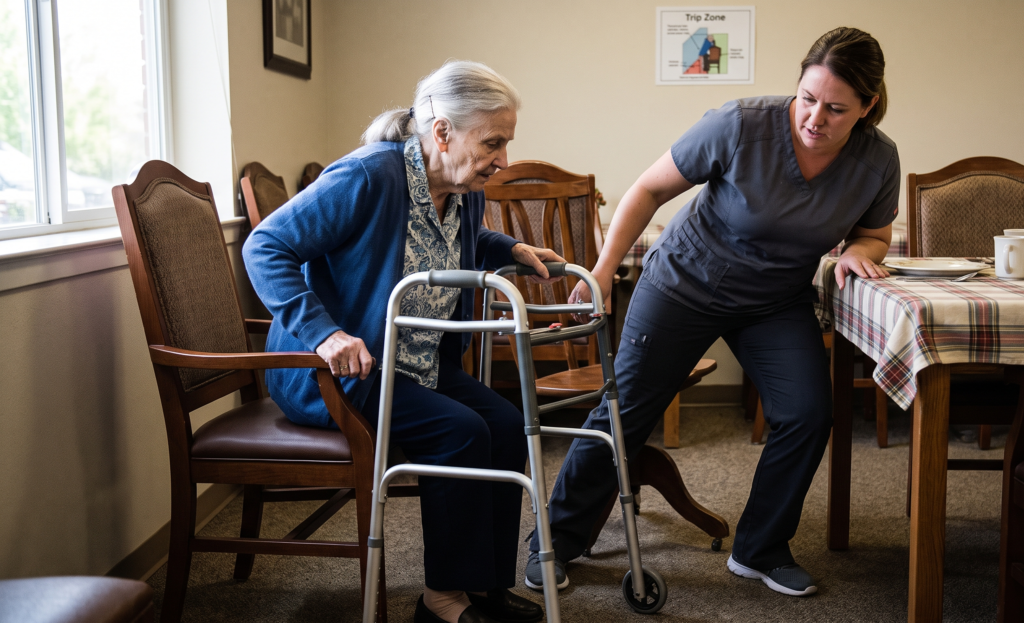
Most dining chairs are conceived around a single moment: sitting. In senior care, however, the most demanding and most dangerous moments happen before and after the meal in the sit-to-stand and stand-to-sit transfers. A dining chair engineered for assisted dining is designed around those transitions, not merely the interval of sitting between them.
That reframing changes almost every dimension of the chair. Armrests, seat height, seat depth, the base, and overall stability stop being style choices and become the mechanics of a safe transfer. Get them right and the chair helps a resident rise; get them wrong and it forces both resident and caregiver into exactly the movements that cause falls and injuries.
Key takeaways
- The transfer sitting down and standing up is where mealtime fall and injury risk concentrates, not the interval of sitting.
- On a care chair the armrest becomes an assistive surface, engineered for a resident to grip, load, and push against safely.
- Seat height and depth, foot placement, and stability under off-centre load together determine whether a transfer is safe.
- Overexertion from patient handling is a leading cause of caregiver injury, so a chair that eases transfers protects staff as well as residents.
The transfer is where risk concentrates
Observe a resident who requires assistance as they approach a standard chair. They turn, reach for balance, lower themselves with limited control, and later attempt to rise from a seat that offers no mechanical help. Each of those is an opportunity for a fall, and each often draws the caregiver into an awkward, forceful assist. Overexertion and bodily reaction from this kind of handling is a leading source of caregiver injury, which is why the transfer deserves to be treated as the primary design case rather than an afterthought.
The biomechanics of standing up
A safe stand follows a predictable sequence: the person slides forward, brings their feet back under their body, leans the trunk forward over the feet, and then rises as the legs extend. Anything that blocks any part of that sequence makes the movement harder and less stable. Age-related changes in strength and balance narrow the margin for error, so the chair’s job is to remove obstacles from that sequence and give the resident something reliable to push against.
Armrest geometry
On a conventional chair, the armrest is largely decorative. On a care chair it becomes an assistive surface positioned and shaped so a resident can grip it, load their weight through it, and push up safely. The height, length, and forward extent of the arm determine whether it genuinely supports the moment of rising or leaves the resident reaching for something that is not where their hands need it to be.
Seat height and depth
A seat that sits too low forces a deep, unstable descent and a strenuous push to stand one of the most common reasons an older adult struggles to rise. A seat that is too deep leaves shorter residents unsupported or unable to reach the backrest, and pushes their feet forward so they cannot get their weight over them. The right geometry keeps the feet flat and planted and lets the hips clear the seat edge under control.
Foot placement and the base
Stable, unobstructed foot placement is the biomechanical foundation of a safe stand, because it lets the resident bring their weight over their feet. A chair base or stretcher bar that interferes with the feet works against every transfer. The footprint also has to provide stability without becoming a trip hazard in the very space where the resident is moving.
Stability under load
During a transfer the chair receives off-centre force as the resident pushes down and forward on one side or on the arms. If it slides, rocks, or tips, it stops being a support and becomes a hazard. Engineered stability is what allows the armrest to be trusted at the exact moment it is needed most.
Designing the whole arc, not one posture
The strongest care seating is designed across the full arc of the meal: approach, descent, support through the meal, and rise. A chair that is comfortable to sit in but punishing to leave has solved the easy third of the problem. Designing for the transfer means holding all of it in view at once, so no single stage is made safe at the expense of another.
Why this matters beyond the individual chair
When a chair is designed around the transfer, sit-to-stand movements become easier, residents rely less on the table for balance, and caregivers apply less force in awkward positions. The DCCS classes progress along exactly this logic, moving from a standard Class A chair through guided and controlled-movement designs that make the transfer safer for resident and caregiver alike.
Frequently asked questions
What is the ideal seat height for an elderly dining chair?
There is no single number, because the right height depends on the resident. The general principle is that a resident should be able to sit with feet flat on the floor and knees at roughly a right angle, without the seat being so low that standing requires a deep, effortful push. Because residents vary, communities benefit from assessing their population with occupational or physical therapy input rather than assuming one height fits all.
Do armrests really help seniors stand up?
Yes, when they are designed for it. An armrest positioned and shaped as an assistive surface gives a resident something stable to grip and push against, which is central to a safe, controlled rise. A purely decorative armrest that is too low, too short, or too far back offers little of that benefit.
What makes a dining chair safe for sit-to-stand transfers?
Four things working together: an armrest a resident can grip and load, a seat height and depth that keep the feet planted and let the hips clear the seat edge, unobstructed foot placement so weight can come over the feet, and enough stability that the chair does not slide or tip under off-centre force.
Can the wrong dining chair cause falls?
A chair that is too low, unstable, or hard to rise from can contribute to falls at the moment of transfer, and standard chairs that must be manoeuvred can force residents to shuffle and lean for balance in the space in front of the table a location where trips and falls commonly occur. Seating designed around the transfer reduces both risks.
Download the complete DCCS Decision Guide (PDF) for the full A–D framework and class-by-class detail. To discuss your community’s dining room, contact us or call 1-888-678-2060.