INTRODUCTION
In the language of the Dining Chair Classification System, two words carry more weight than any others: full access. They describe a design principle that is simple to understand, immediately visible in operation, and profoundly consequential for every resident who requires mealtime seating assistance.
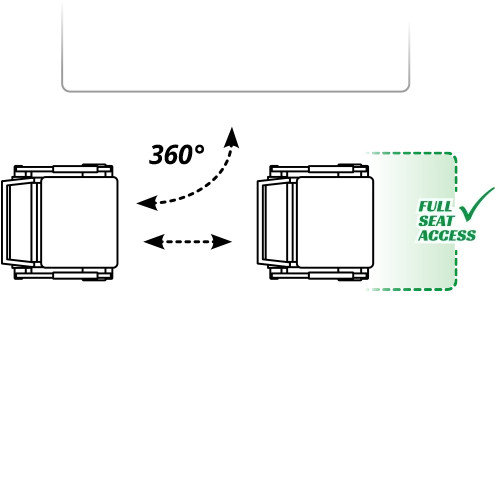
Full seat access means that a resident can be seated from the front — approaching the chair directly, lowering into a well-supported seat without lateral movement, and being guided to the table without any of the shuffling, backward-stepping, or table-edge balancing that defines the standard chair experience.
It sounds almost obvious when stated plainly. The reason it is remarkable is that standard dining chairs — the chairs in virtually every senior dining room — do not provide it.
What Full Seat Access Actually Means in Practice
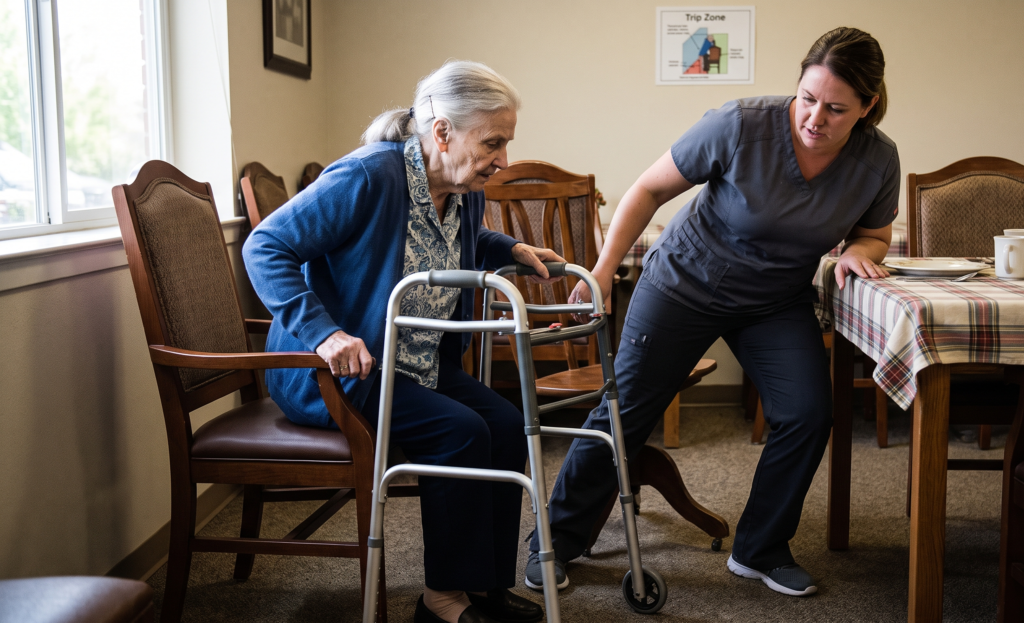
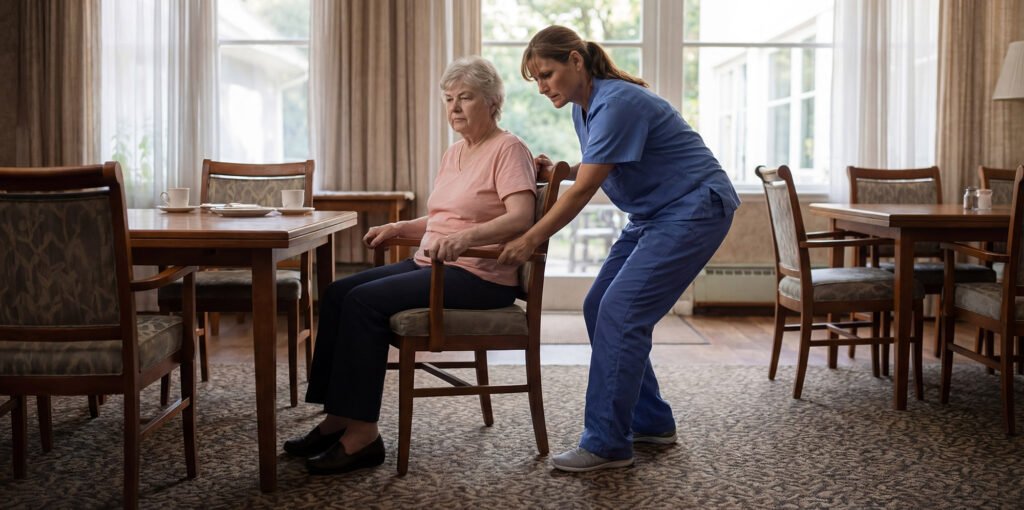
Imagine a resident with mild balance impairment approaching their seat at the dinner table. With a standard chair, they must approach from the side while the caregiver angles the chair away from the table. They must lower themselves onto an offset seat while the caregiver supports from behind. Once seated, they must hold their position while the caregiver pushes the chair forward — a movement that requires the caregiver to exert sustained force against the weight of the occupied chair and the resistance of the flooring.
Now imagine the same resident approaching a Class B or Class C chair. The chair is brought to them, positioned directly in front of the seat opening. They lower straight down — forward-facing, with their natural center of gravity over the seat. The caregiver guides the chair to the table in a single smooth movement, without backward stepping, without lateral redirection, without the resident leaning on a table edge for balance.
This is what full seat access looks like in operation. It is not a subtle difference. Staff who have worked in facilities that have made the transition describe it as night and day.
Why Standard Chairs Cannot Provide Full Seat Access
Standard dining chairs block full seat access by design. The table leg, combined with the chair’s rigid positioning, creates a geometric problem: there is no path to the seat from the front when the chair is at the table. The chair must come away from the table and angle to allow approach — and the further it comes away, the more the Trip Zone expands.
Chairs designed for full seat access solve this problem through controlled movement that allows the chair to move away from the table, receive the resident from the front, and return to the table in a single action. The chair does the navigating. The resident and caregiver do the caring.
Full Seat Access Across DCCS Classes
Full seat access is a defining characteristic of DCCS Classes B, C, and D. Each class achieves it through different mechanisms appropriate to different levels of care need.
Class B chairs provide guided mobility with controlled positioning, eliminating table interference while maintaining stability. They are appropriate for residents who need occasional support.
Class C chairs add caregiver-directed movement and manual braking — the caregiver controls where and how the chair moves, making them appropriate for residents who need significant assistance or who cannot participate in the seating process.
Class D chairs extend this to resident-controlled mobility with braking, designed for residents who are capable of directing their own movement but need controlled stability to do so safely.
In each case, the underlying design principle is the same: the chair moves to serve the resident, rather than the resident navigating around the chair.
The Fall Prevention Implications
Falls in senior care are most likely to occur during transitions — the moments when a person is moving between states, between surfaces, between positions. The seating and unseating process at the dining table is a transition that happens multiple times daily for every resident.
Full seat access eliminates the most dangerous elements of this transition: the lateral movement, the backward stepping, the loss of forward visual orientation. It replaces them with a controlled, forward-facing sequence that maintains stability throughout.
Risk management professionals evaluating fall prevention protocols increasingly recognize that the physical environment of the dining room is not a neutral backdrop to the fall prevention work happening elsewhere in the facility. The chair at the table is either working for fall prevention or working against it. Full seat access is how the chair works for it.