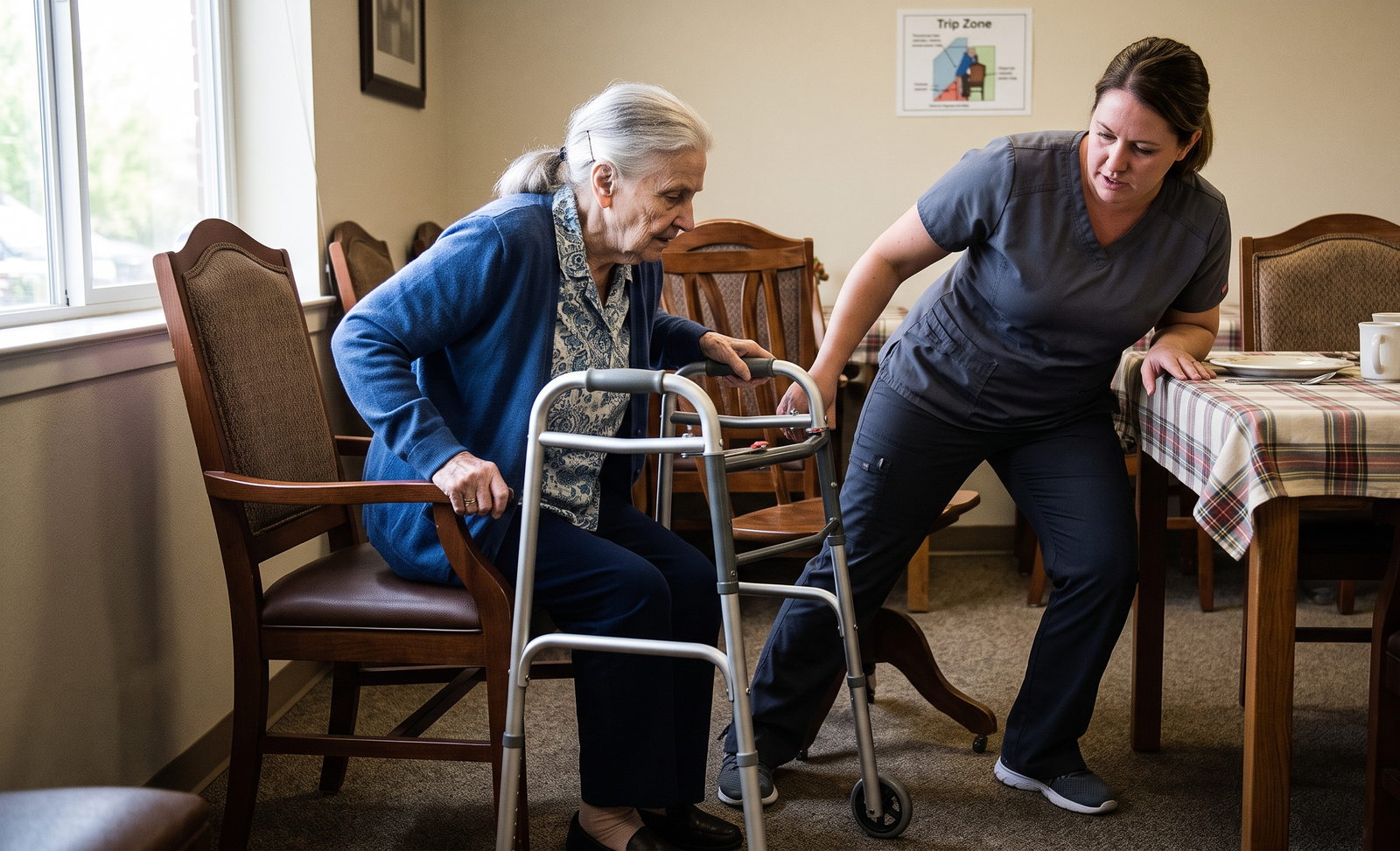
There is a term that experienced care professionals rarely use but immediately recognize when they hear it: the Trip Zone. It describes the area immediately around the front of a dining table the space where a resident and their caregiver must occupy the same narrow geometry at the same moment, one of them in the process of transferring weight, neither of them with a clear path of movement.
The Trip Zone is not dramatic. It does not announce itself. It is simply the spatial consequence of using a chair that was never designed for assisted seating in a space that was never engineered to accommodate it. And it is present in nearly every senior dining room in North America right now.
How the Trip Zone Forms: The Geometry of Standard Chair Seating
A standard dining chair cannot be positioned directly in front of the table when a resident needs seating assistance. The table is in the way. To seat the resident, the caregiver must pull the chair out and angle it typically at 45 degrees to create enough space for approach.
This angled position is the beginning of the Trip Zone. From this position, the resident must approach from the side, lower toward the seat, and then once seated be moved forward while the chair is pushed back toward the table by the caregiver standing behind.
During this sequence, the space directly in front of the table is occupied by a chair at an angle, a resident in transition, and a caregiver moving backward. There is no clear path. There is no stable point of reference. The table edge becomes the default handhold for both parties.
The Three Movements That Create the Hazard
The DCCS identifies three specific movements that define the Trip Zone experience for resident and caregiver alike.
The first is shuffling sideways. Because the chair is angled and the table restricts forward approach, both parties must move laterally a direction that is inherently less stable than forward movement, particularly for residents with balance impairments.
The second is stepping backward. The caregiver must step away from the resident as the resident lowers into the seat, then push the chair toward the table while walking backward. Stepping backward while managing another person’s weight is a documented contributor to caregiver falls and near-falls.
The third is leaning on the table. Both residents and caregivers instinctively use the table edge for balance during this sequence. A table is not a support structure for human weight in motion it can shift, its edge can cause injury, and leaning on it transfers instability to any resident already seated at that table.
These three movements happen simultaneously, in a small space, at every meal, for every resident who requires seating assistance.
Who Is Most Vulnerable in the Trip Zone
Not every resident is equally at risk in the Trip Zone. Residents who can independently approach a chair, lower themselves with full control, and adjust their position at the table are largely unaffected by its hazards.
The residents who bear the greatest risk are those who are partially dependent individuals who can walk with support but cannot safely manage the lateral shuffling and weight-shifting demands of the standard chair transfer. This population is often the largest in any assisted living or long-term care facility: residents who are mobile but not fully independent, who need a hand but not a lift, who look fine until the moment they are not.
For this population the semi-dependent majority in most care communities the Trip Zone is an active hazard at every meal.
Eliminating the Trip Zone With the Right Chair Design
The Trip Zone disappears when the chair can approach the resident rather than the resident approaching the chair. This is the design principle behind DCCS Classes B, C, and D seating that provides full seat access from the front, without requiring the angled approach that creates the zone.
Full seat access means the resident can lower directly into the chair while facing forward. The chair can be brought to the resident, positioned, and moved to the table without any lateral shuffling, backward stepping, or table-edge balancing. The entire sequence changes from a navigation problem to a care interaction.
Facilities that have redesigned their dining rooms around full-seat-access chairs describe the change as immediately visible: caregivers move more efficiently, residents are calmer during seating, and the mealtime environment shifts from tense to settled.