The need to review issues associated with dining services in senior living communities is becoming increasingly important as the operational costs of caring for residents with reduced mobility continue to rise.
Premature replacement of dining chairs and flooring (5–7 years instead of the projected 10–12 years) creates significant unplanned expenses.
Labour shortages, reduced access to immigrant workers, and an aging workforce including early retirees returning to work, also contribute significantly to the overall cost of care.
Developing a dining chair classification system that prioritizes durability, floor protection, caregiver ergonomics, and resident independence helps reduce lifecycle costs while supporting safer, more dignified care.
Premature replacement of dining chairs and flooring (5–7 years instead of the projected 10–12 years) creates significant unplanned expenses.
Labour shortages, reduced access to immigrant workers, and an aging workforce including early retirees returning to work, also contribute significantly to the overall cost of care.
Developing a dining chair classification system that prioritizes durability, floor protection, caregiver ergonomics, and resident independence helps reduce lifecycle costs while supporting safer, more dignified care.
Preliminary findings associated with providing improved chair design solutions for dependent care communities are as follows:
As Care Needs Change...
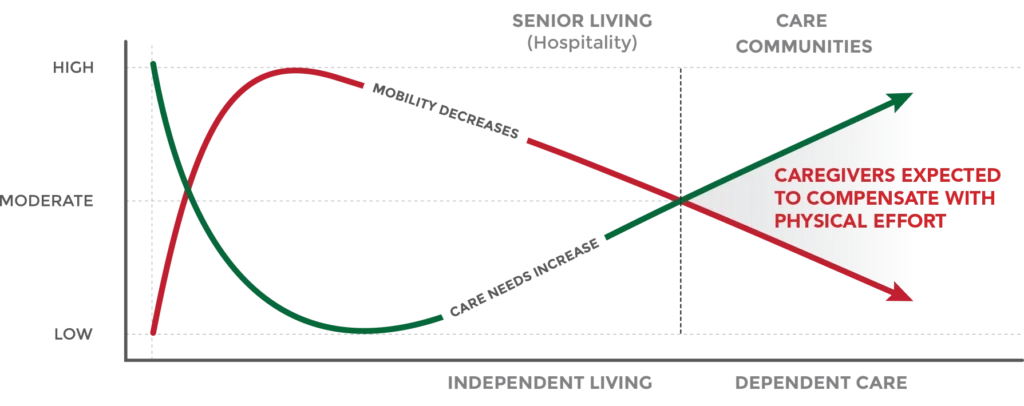
Care needs change when a senior’s mobility decreases to the point that a caregiver is required to provide assistance getting him/her seated and moved into position at the table.
Observations:
- The need for physical assistance when seating persons with reduced mobility at mealtimes may indicate that traditional dining chair designs are incomplete or inadequately suited to the task.
- Dining chair designs have changed very little over the past two decades. Chairs equipped with casters on only the front or rear legs were not originally designed to reduce the physical demands placed on care staff during mealtime assistance.
- The “TRIP ZONE” remains a significant obstacle when caregivers assist residents into traditional dining chairs. This creates ongoing fall risks for seniors and increases the likelihood of work-related injuries for staff, even when accepted transfer techniques are properly followed.
- Many care communities have successfully returned existing chairs to active service through the addition of the retrofittable Chair CADDIE. This suggests that conventional chair designs may not be well suited to supporting persons with reduced mobility.
- Extending the usable life of existing chairs through retrofitting can help reduce annual operating costs by decreasing the frequency of chair and flooring replacement.
- There is growing evidence that the swivel-locking action incorporated into certain chair designs increases residents’ awareness and appreciation of the physical effort caregivers expend during mealtime assistance.
- Anecdotal observations indicate that residents experiencing cognitive impairment may be less agitated and more cooperative with staff during mealtimes when assisted using mobility-enhanced chair designs.
- Because dining rooms are highly visible care environments, chair designs that reduce the awkwardness of seating and table access may improve a resident’s sense of dignity, comfort, and self-worth.
- The broader financial benefits of reducing physical demands on caregivers—including potential reductions in overtime, absenteeism, and insurance-related expenses—have not yet been fully documented and warrant further study.
- Reduced physical workload demands may positively influence both recruitment and retention efforts within care communities. Early retirees could represent a valuable labor source where physical job requirements remain manageable, while lower physical strain may also contribute to improved long-term staff retention.